


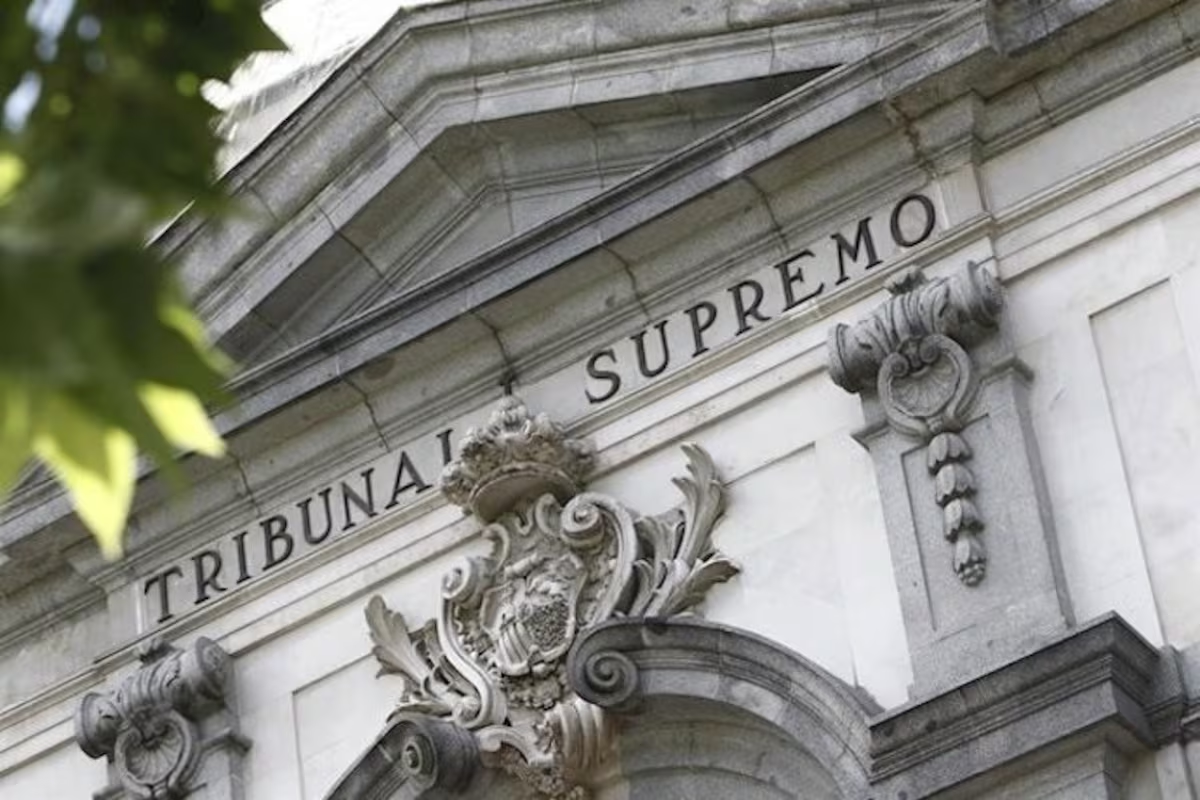
Mortgage opening fees are not inherently prohibited. The Supreme Court has affirmed in a recent ruling that these fees are lawful, provided they are clear, understandable, and not excessive. The court considers the first requirement met if the fee is individualized, its terms are highlighted, and it is clearly a one-time initial payment. The second condition is determined by the average cost of such fees, ranging from 0.25% to 1.5%. While many major banks have eliminated these fees due to strong competition, Bankinter and Unicaja still apply them.
The banking sector’s rationale for charging a percentage of the mortgage loan at the time of its issuance is supported by a Supreme Court decision from July 22, accessed by CincoDías. The legal journey began five years ago when a lower court sided with a Liberbank customer (now Unicaja Banco) and nullified a fee for formalizing a 2005 loan for purchasing a home.
The financial institution embarked on a lengthy battle to uphold the fee’s validity, initially appealing the decision. Months later, the Provincial Court of Oviedo dismissed the appeal. However, the bank, led by José Sevilla, persisted and took the matter to the Supreme Court. After a year, the Supreme Court ruled in favor of the bank, reinforcing its own doctrine established in April of the previous year.
The ruling clearly states that banks can include such fees in mortgages if they meet specific formal requirements that ensure transparency and are not excessive. The judgment outlines four simultaneous conditions for validating the fee regarding transparency, as per the regulations at the time of issuance. These include covering any study, granting, or processing costs; being part of a single fee called ‘opening fee’; being paid in one installment; and specifying the amount, form, and date of settlement in the clause itself. ‘All these parameters are met in the case of the disputed clause,’ the court concludes.
The fee of approximately 700 euros also meets the proportionality criterion, representing 0.65% of the capital, within statistical parameters for opening fees in similar transactions at that time, given that the average cost of opening fees in Spain ranged from 0.25% to 1.5%. ‘From all of this, it can be concluded that, in this specific case, the clause imposing the opening fee was transparent and not abusive,’ states the Supreme Court.
Concerns about the opening fee date back to 2020, when the Court of Justice of the European Union (CJEU) scrutinized it after resolving doubts from two Spanish lower courts. The highest interpreter of European law determined that national judges were competent to declare opening fees abusive, disagreeing on some points with the Supreme Court’s ruling, which had stated that the fee was excluded from substantive control, considering it part of the price and outside the main influence area of the contract.
The Luxembourg Court triggered legal uncertainty on the matter, leading to a wave of divergent verdicts regarding the clause’s validity. The Supreme Court decided to intervene, referring the issue back to the CJEU through a preliminary question in September 2021, arguing that the ruling causing chaos was based on partial information about Spanish regulations.
The response arrived about two years later, when the European court clarified two key points. First: yes, the fee is subject to Spanish judicial oversight, but with several caveats. Second, a one-size-fits-all approach cannot be applied. The Supreme Court accepted the challenge and meticulously set criteria to consider the fee valid or invalid.